
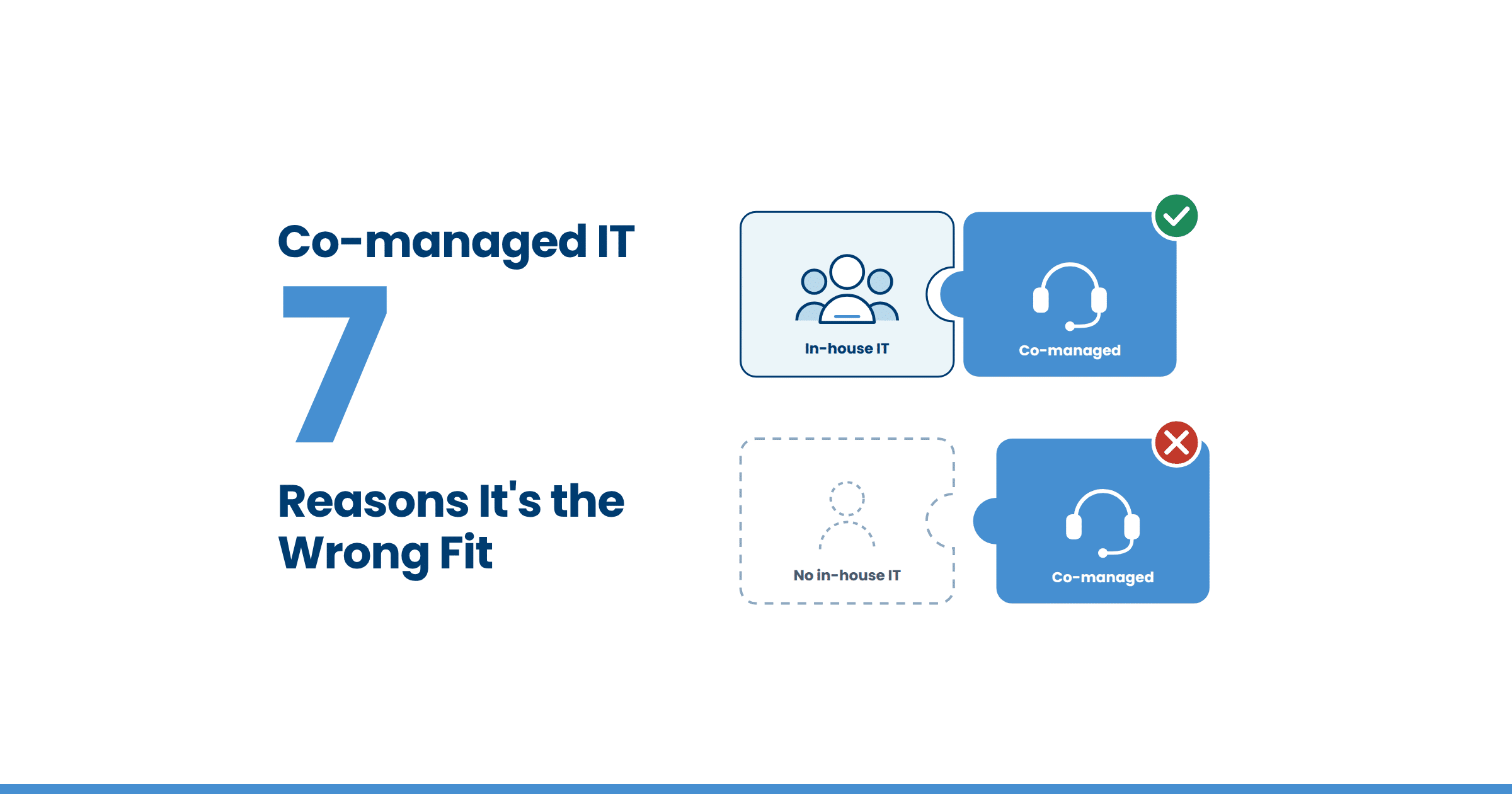
A co-managed IT provider solves one problem well: you have an internal IT team, and the work has outgrown the people on it. When that is not your actual situation, the contract underdelivers no matter how good the provider is. Here are six cases where something else is the better purchase, and what that something else is called.
Key Takeaways
- Co-managed IT only works when there is existing in-house IT staff to share the work with.
- If you need a specific person under your own direction, you’re looking for staff augmentation.
- Short-term surge work and scoped projects belong in project agreements that include end dates, not ongoing operational contracts.
- Some issues are related to tooling or executive direction rather than related to the IT team’s size. Buying more support hours will not close either one of those.
Table of Contents
What Co-managed IT Services Were Created to Solve
Co-managed IT services are a shared operating model. Your internal IT team keeps ownership of the environment, institutional knowledge, and day-to-day priorities, while an external provider takes defined pieces of the work.
That might look like after-hours coverage, specialized security functions, compliance evidence, as well as projects nobody on your team has time for.
Every responsibility is split by function and written down for accountability purposes.
This outsourced IT structure assumes two things:
- 1. That someone on your team is accountable for IT and will direct the relationship with the provider.
- 2. That the issue you are trying to solve requires ongoing management rather than finite support.
Below are six situations where you might be looking at co-managed IT services, but it’s the wrong solution for you.

7 Situations Where Co-managed IT Services Are the Wrong Fit
1. You need staff augmentation.
You’re looking to bring in an individual to fill a skill gap or capacity shortage on your team.
Staff augmentation places a named individual under your direction, on your tickets, in your stand-ups, following your process. It’s a great solution when you just want some project work done.
Co-managed IT gives you a team that arrives with its own management layer, its own escalation path, and its own way of working. Co-managed IT services are generally used to solve for operational gaps (for example, compliance expertise + tier 1 help desk support or tier 2 help desk tickets, vCIO and occasional project support).
Both add capacity. Just in different ways.
If you want to assign tasks to a person that you choose, you want a technical staffing firm or a contract-to-hire arrangement. A co-managed agreement in this situation will frustrate everyone.
If your answer is, “I want a portion of our work covered, and I do not want to manage it,” that’s when co-managed fits perfectly.
Just keep in mind that a contractor is not automatically cheaper than entering into a co-managed agreement. Benefit costs alone averaged 30.0 percent of total employer compensation costs for private industry workers in June 2026, according to the Bureau of Labor Statistics. So, a staffing firm’s markup sits on top of a fully loaded rate.
Does Teal provide staff augmentation?
Teal does not place individual contractors under your direct management. We share responsibility across a team – which is a very different arrangement than adding someone to your org chart. We can supplement your team with someone from ours, but it’s often for a short period of time and not a common arrangement.
If you’re looking for true staff augmentation where someone is under your direction and short project support, a technical staffing firm is the better option for you.
2. You need surge capacity.
You’re an organization looking for temporary, extra support – such as retail during the holidays, a nonprofit moving offices, or a wealth management firm with a one-time system rollout.
In situations like these, organizations need eight weeks of extra hands. A co-managed IT contract priced per user per month doesn’t make sense in this scenario, unless you have other IT support needs.
Hiring for surge capacity is typically filled with frustration. The NIST-led NICE program counts 457,398 open cybersecurity positions in the United States as of June 2025. And technical roles broadly take longer to fill than a surge window lasts. By the time you have someone at a desk, your peak demand will have passed.
In this scenario, your options are to:
- Work with a staffing firm to find short-term contractors
- Work with a managed IT services provider that offers one-off project support (ask a provider directly whether they will do work on those terms)
- Work with a co-managed IT service provider to fill this need as well as other operational support (e.g., help desk, compliance, cybersecurity, AI, etc.)
Does Teal provide surge capacity support?
Teal offers ongoing support to small and midmarket businesses as well as nonprofits. We will absolutely provide surge capacity support to our co-managed IT clients, but we don’t provide support for short engagements.
If you’re looking to outsource M365 optimization, user lifecycle management, vendor renewals AND have access to surge capacity, we are absolutely an option for your organization.
3. You need better tools.
You want to increase your team’s size, but what you really need are the right tools to do your job more efficiently.
Your team is drowning in work, so the answer must be more hands, right? Well, sometimes. You might just be in a situation where three engineers are doing a job manually that a properly configured RMM, an automation layer, or a SIEM would do on its own.
Adding people to an under-tooled environment scales the manual work rather than removing it. And recent spending patterns back this up.
Gartner projects security software spending rising from $105.9 billion in 2025 to $121.2 billion in 2026, growing faster than security services over the same period. So, organizations are buying capability to add to their stack.
Run the diagnostic before you shop for support. Where is your team spending hours on work a machine should handle, like:
- Patch verification
- Onboarding and offboarding
- Alert triage
- Evidence collection for audits
- License reconciliation
If most of your backlog sits there, a tooling and automation project is likely the better investment – unless you have other needs.
Does Teal provide best-of-breed tools?
Yes. If you’re in a situation where you’re looking for an MDR vendor, for example, and could also use some help desk support. That’s a situation where we could help. We could enter a co-managed agreement where we provide you with managed detection and response with a 24/7 SOC and tier 1 support.
Or maybe you want managed intelligence services plus M365 and Domain / Entra ID Administration, M365 backup, and compliance support for ISO 27001.

4. You need complete operational support.
If you’re an IT leader or executive who wants to offload all of the IT functions to a vendor, co-managed is not the right option for you.
Co-managed IT only makes sense when there is an existing in-house IT person who will manage IT functions alongside the outsourced IT service provider.
In a co-managed agreement, someone internally has to own change approval, set priorities, hold the admin accounts, and make calls on the provider’s escalations. With no one in that seat, a company’s escalations will go nowhere, and the arrangement will fail.
What you’re actually looking for is fully managed IT services.
Does Teal provide complete IT support?
Yes, Teal, the parent brand at tealtech.com, handles fully managed IT services. You can visit our managed IT website to learn more or speak directly with a senior Teal advisor about outsourcing all of your IT functions.
5. You need project support.
You’re looking for support with tasks like cloud migration, ERP deployment, network redesign, technical due diligence on an acquisition, or a NIST 800-171 gap analysis.
Projects like these are scoped, have a finish line, and do not require an ongoing operational partnership. Signing a co-managed contract to get them done is overkill and leaves you paying a monthly fee long after the project is finished.
If you only need project support, you should look into these options instead:
Hire a project-based IT consultant.
- Best for: complex, high-risk architectures needing expertise
Use a staffing firm for vetted contractors.
- Best for: extra manpower
Use the vendor’s professional services division for support
- Best for: ensuring new hardware/software deployments align with manufacturers’ optimal configurations
Use a platform like Toptal to source vetted, freelance developers, DevOps engineers, or cybersecurity analysts
- Best for: independent validation, niche scripting, code reviews, short-term technical troubleshooting
That said, hiring a co-managed IT provider for project support (like a gap analysis) AND other tasks (like ongoing managed cybersecurity services) makes a lot more sense.
Does Teal provide support for projects?
Yes, with one caveat: we must also be providing co-managed IT services to the business. For example, during the interview process, you might explain to us that you’re looking for comprehensive cybersecurity support and would also like assistance with a migration from Google to M365. We could absolutely do that because you’re looking to enter into a long-term agreement.
But if you’re looking for support for a one-off project, we’re not the right solution for you.
6. You need strategy and leadership.
You need strategic direction from someone who has many years of experience.
Sometimes your issue is not about increasing hands at all. It’s that nobody is building a three-year roadmap, managing vendor relationships at a portfolio level, or translating IT moves into language that your board will act on. That is a virtual CIO or virtual CISO engagement.
Co-managed IT is operational support, and operational support does not – by itself – produce strategic direction. However, some providers offer vCIO and vCISO support as a block of hours. So, if you have other IT needs, co-managed IT might be a good fit with the right provider.
- Related content: See our guide to IT consulting services.
Does Teal provide strategy advisory?
Yes, Teal offers vCIO and vCISO engagements, with quarterly strategic business reviews as part of the standard cadence. This support can be folded into your co-managed IT agreement.
7. You don’t have a lot of IT needs.
You work in a small business with a single location, no compliance obligations, and straightforward infrastructure may be better served by a “break-fix” or “as-needed” IT support relationship.
Co-managed IT services are not the right fit if your IT needs are genuinely minimal. Watch your hours closely, though, because break/fix support looks cheap right up until you blow past your estimate and spend more than you anticipated under this model. It also won’t be the best solution forever.
As the organization grows, you’ll hit a point where you’ll want to either hire in-house staff or move to co-managed IT. Track your growth goals against your break-fix hours, and you’ll see the tipping point coming before it costs you in overtime hours or a scramble to hire.
Does Teal provide break/fix support?
No, Teal provides clients with the opposite. They enjoy proactive IT support. However, if you have any questions about break/fix support, our senior advisors are happy to provide you with guidance before you hire a firm.
How Do You Know Which of These You Need?
Ask whether your need has an anticipated end date, whether someone internal can direct the work, and whether the bottleneck is hours, tools, or direction. Those three answers will route you to the right model faster than any IT provider’s discovery call.
| If you’re looking for… | You need: |
|---|---|
|
A person that you will manage, long or short term, with specialized expertise |
Staff augmentation or a direct hire |
|
Surge capacity during busy times of the year |
A staffing firm to find short-term contractors or a managed IT services provider that offers one-off project support.
Or, a co-managed IT service provider when you have project and operational needs (e.g., help desk, compliance, cybersecurity, AI, etc.). |
|
Extra support, but those tasks could be done by an available tool… |
Tooling, automation/managed intelligence services, RMM/SIEM investment or co-managed IT (w/tools and for other operational needs) |
|
No internal IT function at all and have needs such as compliance, cybersecurity, and growth support |
Fully managed IT services |
|
Project support |
Project-based professional services, IT consultant, a contractor, or a freelancer.
If you have project and other IT needs, then get co-managed services. |
|
Strategy and leadership |
vCIO or vCISO engagement
If you have strategy and operational needs, co-managed IT services can offer vCIO and vCISO advisory |
|
Ongoing proactive support, strategy advisory, best-of-breed tooling and/or specialized expertise |
Co-managed IT services |
|
Limited IT support and work in a business with a single location, no compliance obligations, and straightforward infrastructure |
Hire a “break-fix” or “as-needed” IT support provider |
When Co-managed IT Services Are the Right Call After All
Strip out the six situations above, and one profile remains. You have an IT team (or more often IT leader) that knows the environment and does good work, but the volume has grown larger than they can manage alone, or the job now demands depth they don’t have. Depth in areas like:
- Cybersecurity operations
- Compliance evidence
- Cloud architecture
- AI adoption and automation engineering
That is the case co-managed IT was designed for.
Matching Your IT Support Model to the Issue You Actually Have
Ruling out co-managed IT services costs you nothing. If anything, it saves you a conversation, plus the time and money you’d waste chasing the wrong solution for your problem. If the co-managed profile above sounds like your team, the next step is checking the signs that co-managed IT support is a good fit, then price what a co-managed IT investment looks like. If it doesn’t, at least you now know what to search for instead.