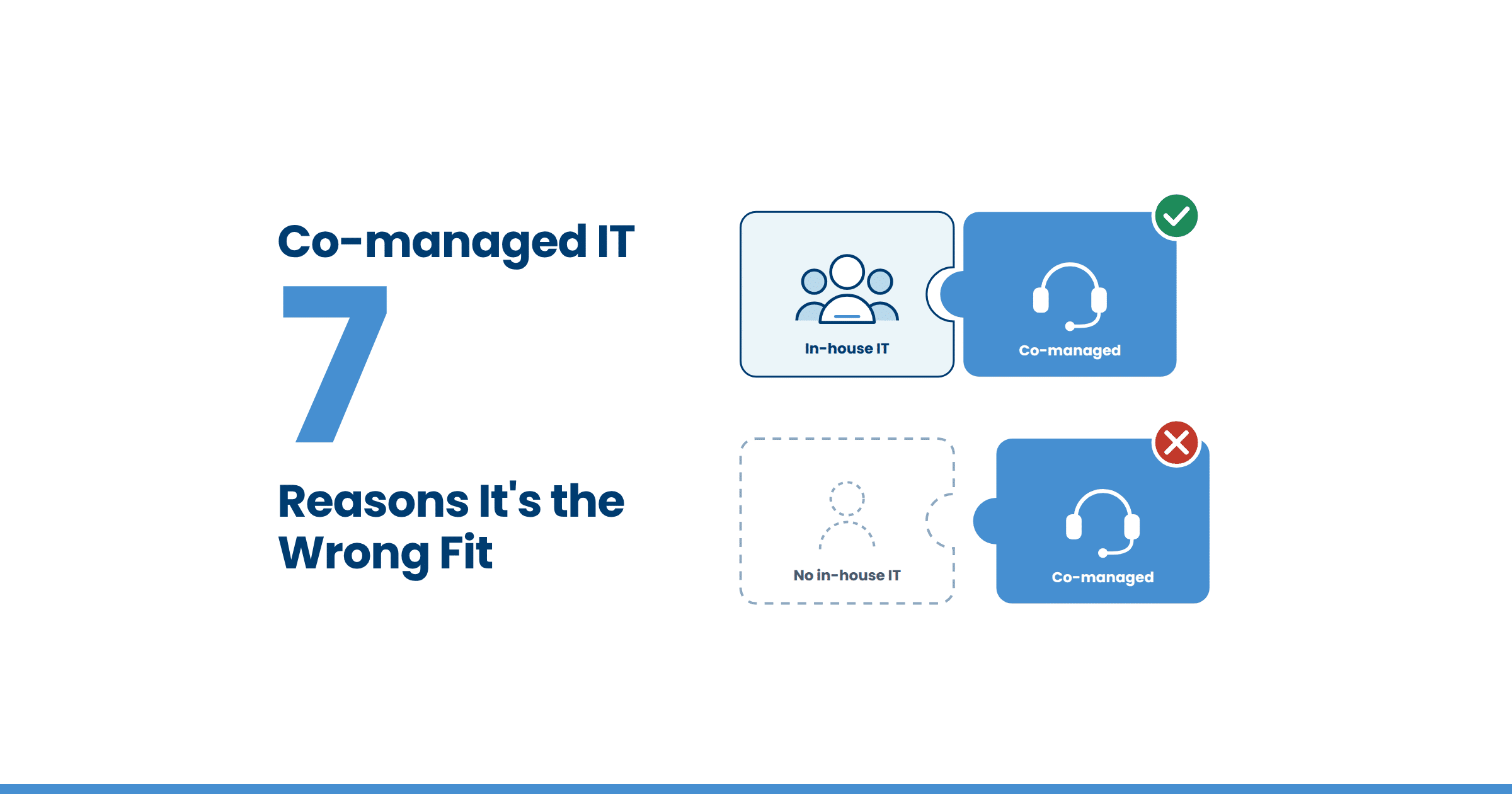

If your team is solid but drowning in tickets, hitting skill walls, or staring down a compliance requirement with no clear path forward, co-managed IT may be exactly what you’re missing. Here’s how to know for sure.
Key Takeaways
- Co-managed IT services extend your in-house IT team rather than replacing it, making it a fit for organizations that already have IT staff but not enough of them.
- Skill gaps, compliance pressure, rapid growth, and single points of failure are the most common triggers for adopting co-managed IT support.
- Co-managed IT is not the right answer if you don’t have an IT team. That’s a fully managed IT conversation.
- The right co-managed IT provider documents everything, knows your industry’s compliance requirements, and has clear SLAs for escalation.
Table of Contents
What is Co-managed IT?
Co-managed IT services is a model where an external managed service provider works alongside your existing internal IT team, filling gaps rather than replacing them. Your team keeps ownership of institutional knowledge and day-to-day operations. So, you’re not handing the keys over. The MSP simply extends your capacity with on-demand expertise, monitoring, and coverage you couldn’t justify hiring new staff full-time to manage.

7 Signs Co-managed IT Support is the Right Fit for You
Use this as a diagnostic tool. The more of these your organization is dealing with, the stronger the case you have for seeking out co-managed IT support.
1. Your in-house IT team is overloaded with tasks.
Tickets keep piling up, nothing critical gets the attention it deserves, and your team is constantly reactive. Your team is productive, but you have a capacity problem. Co-managed IT services absorb the overflow. So, your team can focus on the tasks of your choosing, without having to hire new staff, which is far more expensive.
2. You have skill gaps in specialized areas.
Your team is very familiar with your environment. They’re competent on day-to-day support. But when a security incident happens, leadership asks questions about moving to Azure, or an auditor starts asking about your endpoint detection and response coverage…things get uncomfortable because your knowledge is sparse.
According to IDC, nine out of ten organizations will feel the impact of the IT skills gap by 2026, accounting for $5.5 trillion in losses globally. A co-managed IT provider gives you fractional access to specialists in cybersecurity, cloud infrastructure, compliance, and AI.
3. You operate in a regulated industry or have elevated cyber risk.
Finance firms, healthcare, and defense contracting all share one thing in common:
Frameworks like HIPAA, CMMC, SOC 2, and ISO 27001 demand:
- 24/7 Monitoring
- Formal controls
- Documented incident response
- Regular audits
It’s likely that your team probably can’t sustain the compliance work alongside your day-to-day tasks…and you shouldn’t have to. A co-managed IT provider with extensive compliance experience helps you close those gaps, often without needing to rebuild your entire infrastructure.
4. The business is in a growth phase or facing a major project.
A cloud migration, new office buildout, M&A integration, or e-commerce launch creates a temporary surge in IT demand that your team wasn’t sized for. Co-managed IT gives you elastic support that scales with the project and scales back when it’s done. You don’t need to hire full- or part-time staff, and there’s no severance.
(The caveat is that you shouldn’t get co-managed IT services if you only need project support. But if you have project + growth needs, project + compliance needs, etc. then it makes sense.)
5. Your budget can’t support a full IT team.
Hiring individual specialists (a security analyst, a cloud engineer, a compliance manager, etc.) is very expensive and often impossible to justify for 100–500 users.
Co-managed IT gives you access to a full roster of expertise for a predictable monthly fee.
According to Robert Half research, 72% of technology leaders report a skills gap in their department, and 65% had more difficulty finding skilled IT professionals in 2026 than in 2025. That competition drives up salaries and drags out hiring timelines – neither of which helps a team that’s already stretched.
Co-managed IT sidesteps that problem entirely. Instead of competing for talent you may not be able to afford or retain, you get immediate access to a full bench of specialists at a fixed monthly cost.
6. You have a single point of failure on your IT team.
Many IT teams have one person who knows everything. The one who holds all the passwords, understands the legacy systems, and knows why the VPN is configured the way it is. When they leave, get sick, or take a vacation, it’s common that the operations stall. Co-managed IT brings documented playbooks and institutional knowledge continuity – so the business is never one sick day or one resignation away from a crisis.
7. You need 24/7 coverage or after-hours support.
Many IT teams work standard business hours. However, bad actors launching ransomware attacks don’t. Nor do maintenance windows. Or, you might have staff working in countries across the globe who need support.
Co-managed IT services provide overnight monitoring, after-hours support, and weekend coverage without burning out your staff. If you’re relying on one person’s personal cell phone for after-hours emergencies, that’s a sign that something needs to change.

When Co-managed IT Support is Not the Answer
You don’t have any IT staff.
Co-managed IT is a model built around extending the capabilities of an existing internal IT team. If you don’t have one, you need fully managed IT services.
You have minimal IT needs.
Co-managed IT services are not the right fit if your IT needs are genuinely minimal. A small business with a single location, no compliance obligations, and straightforward infrastructure may be better served by a “break-fix” or “as-needed” IT support relationship.
You want someone to own the entire IT strategy.
If you’re looking for someone to set the direction, make final calls, and own the roadmap, that’s a job for:
- A fractional CIO,
- A strategic IT consultant, or
- A fully managed IT services provider
Co-managed IT keeps your in-house IT team in the driver’s seat. If no one at your company wants that seat, then this model isn’t the right fit.
Co-managed IT vs Full Outsourcing: What’s the Difference?
Complete IT outsourcing replaces your internal team. Co-managed IT extends your team’s capabilities. The choice comes down to whether you want to keep internal ownership of your IT function…and most IT leaders at midmarket companies do.
Identifying a Collaborative IT Provider
Not every MSP is set up to co-manage. Some end up taking over, instead of collaborating with your team. Here’s what you should look for.
They document everything.
If your team is dependent on them for institutional knowledge, they’re not co-managing, they’re creating unnecessary lock-in. Look for providers who maintain runbooks, network diagrams, and process documentation that your team owns.
They have experience with your industry’s compliance requirements.
CMMC, HIPAA, and SOC 2 are not interchangeable. Ask for specific examples of how they’ve supported organizations in your vertical.
They have a formal onboarding process.
A provider who can’t tell you exactly how they’ll integrate with your team in the first 90 days is improvising.
They have clear SLAs for response time and escalation.
What gets a same-day response? What triggers after-hours escalation? You should know before you sign a contract with a co-managed provider.

Evaluating a co-managed IT services provider is harder than it looks because most of the red flags don’t show up until you’re already onboarded. Evaluate providers with this co–managed IT red flags checklist.
Is Co-managed IT Right for Your Team?
If your team is already good at what they do, but the job has grown bigger than your team can reasonably handle, then co-managed IT services are worth a serious look. The right co-managed IT provider won’t try to replace your team. They’ll make your team better.