
Despite arming themselves with more tools, many U.S. small and midsize business IT teams are still experiencing significant burnout in 2026. Industry research points to several interlocking causes that are driving this trend (with IT professionals at small and mid-sized organizations reporting higher burnout rates than their counterparts at larger firms). Below are the six key factors contributing to the burnout you might be seeing across your IT team.
Key Takeaways
- IT burnout in small and midsize teams is driven by systemic issues, not individual resilience.
- Alert fatigue and nonstop vigilance are major contributors to workforce fatigue in 2026.
- More tools often increase IT burnout instead of reducing it.
- Chronic understaffing turns every task into an emergency.
- Compliance pressure is becoming one of the fastest–growing exhaustion drivers.
Table of Contents
1. Tool Sprawl
Over the past decade, many IT teams have responded to new challenges by adding point solutions such as:
- Monitoring tools
- Remote access platforms
- Ticketing systems
- Security products
- and more
In 2026, that approach is increasingly collapsing under its own weight. Teams often inherit patchworks of tools from past decisions and vendor “quick fixes” that have created fragmented visibility, duplicated effort, and unnecessary complexity in the environment.
Today, it seems like even the simplest of tasks now require constant context-switching between dashboards and interfaces. All this does is quietly drain productivity and increase cognitive load.
One industry survey of more than 1,000 IT professionals found that nearly half of IT and security professionals (49%) cite too many overlapping tools as one of their top challenges. It’s a signal that the problem stems from a lack of cohesion. And the impact of burnout is measurable.
There’s a direct correlation between tool count and burnout. Fifty percent of teams that manage 16 or more tools report experiencing high burnout, compared to just 17% for teams using five tools or fewer.
When tools demand more maintenance than the problems they were meant to solve, morale erodes, exhaustion sets in, and disengagement follows.
Tool sprawl doesn’t just slow teams down—it actively contributes to burnout by turning IT work into a constant exercise in tool management rather than problem-solving.

2. Understaffing
Across IT, the scope of responsibility has expanded exponentially. Yet, in many small and mid-sized organizations, headcount hasn’t grown to match.
So, understaffing turns everyday work into a grind.
And when there aren’t enough people to absorb routine support (let alone projects and security demands), everything feels urgent.
The Workload Dilemma
In 2026, IT teams are widely expected to support more endpoints, more cloud services, and more 24×7 operations without proportional increases in staffing. That expectation isn’t limited to one city or region.
While workload intensity varies by market, the underlying issue is widespread (interesting fact, Washington DC was ranked the most overworked city in America in 2025). Over time, that chronic overload leads directly to stress, fatigue, and burnout.
Workload Trends
A 2023 survey found 37% of SMB workers felt more burned out than the year prior, with tech employees among those most affected by relentless workloads and constant priority changes.
A Gartner peer survey from 2023 found that 68% of IT leaders said an unmanageable workload was the top burnout factor for their teams.
In 2024, 58% of IT workers said they felt overwhelmed by their daily tasks and couldn’t keep up with all of the support tickets coming in.
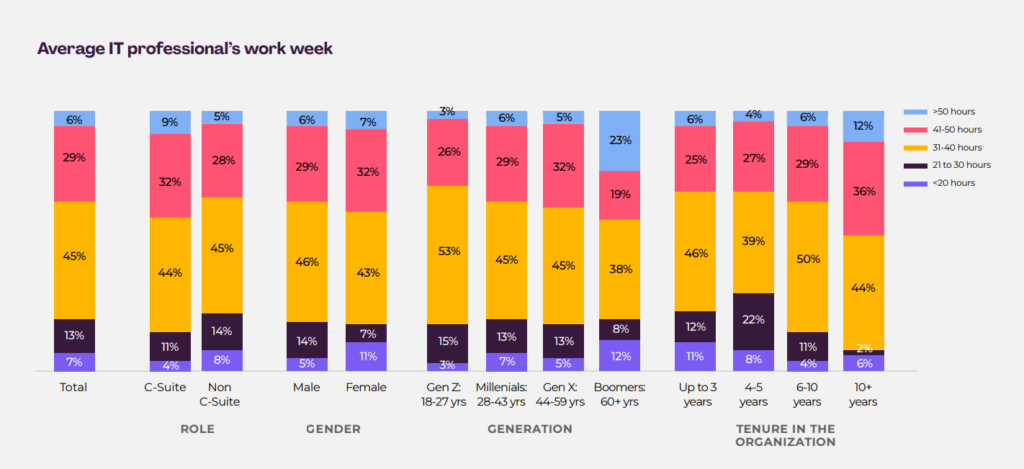
A 2025 IT Trends report by Auvik found that IT professionals in the Boomer generation – as well as those with 10 years or more experience in the field – are much more likely to be working 50+ hours in a week.
What We See on the Ground
We speak with IT pros dealing with this every day, so we know how heavy the load can get. Recently, Gar Whaley spoke with a team of two supporting over 100 employees. They were handling tickets, projects, security, and more with zero support….
Which was the exact reason they were talking to us about our co-managed IT services. They just needed to offload some of their work so they could breathe again and focus on their strategy.
3. Misaligned Priorities
Burnout isn’t just driven by long hours. It’s also driven by how meaningful the work feels.
Many tech professionals find themselves trapped in reactive, low-value tasks that don’t align with the broader business goals. Over time, that disconnect breeds frustration and cynicism – especially when there’s little control over how work is prioritized/executed.
Gartner research shows that a lack of autonomy and misalignment between IT work and organizational goals are cited by roughly 45% of IT leaders as key contributors to burnout.
In practice, this often means days consumed by maintenance, firefighting, and managing fragmented tools leave very little time for strategic initiatives or professional growth.
One industry report describes this as a “strategy deficit,” noting that mid-market IT teams may spend 50–75% of their time on tool upkeep instead of proactive improvements that reduce risk and complexity. That imbalance takes a tangible toll.
When IT professionals feel like they’re “babysitting” technology instead of delivering value, morale drops and disengagement sets in quickly. And that problem is compounded when there’s limited recognition or support from leadership.
A U.S. survey found that 30% of workers attribute burnout to a lack of manager support. This is a dynamic that can be especially pronounced in SMBs, where IT work is often invisible unless something breaks.
When priorities are misaligned, and effort goes unacknowledged, IT teams begin to question the purpose and value of their nonstop work…creating fertile ground for burnout.

4. Work Structure
The burnout your office is experiencing may be caused by how work is structured. As CIO.com notes, IT and security teams are increasingly trapped in a firefighting cycle driven by overlapping tools and nonstop change.
Teams are often asked to adopt new platforms and security controls before the last rollout has settled, all while maintaining legacy systems. That overlap forces constant context switching, with engineers bouncing between systems just to keep operations afloat.
Broader research shows that 35% of employees report severe stress from continuous workplace change, and 67% expect the pace of disruption to accelerate.
In that environment, firefighting becomes the default operating mode. This leaves strategic, proactive work that never gets sustained attention.
Over time, even well-equipped teams burn out, because the way the work is organized makes stability impossible.
5. Alert Fatigue
Alert fatigue is one of the clearest drivers of IT burnout today. Sophos’ Addressing Cybersecurity Burnout in 2025 report calls burnout the “human cost of vigilance,” and the data backs it up.
In a survey of 5,000 IT and cybersecurity professionals across 17 countries, 76% reported experiencing burnout or fatigue, with 69% saying it worsened year over year. Sophos links this directly to nonstop alert pressure, rapid response expectations, and the high stakes of getting it wrong.
When teams are expected to stay perpetually vigilant, there aren’t really any quiet days. Even when nothing is actively wrong, the mental load of monitoring, triaging, and second-guessing alerts adds up.
And over time, constant readiness leads to disengagement rather than resilience.
39%
of respondents reported reduced productivity
46%
reported increased anxiety about cyberattacks & breaches
33%
reported lower engagement at work
This is why piling on more security tools doesn’t always make teams feel safer. Even if only a small fraction of alerts require action, every alert still demands attention.
And for many in-house IT teams, the noise never stops.
In that environment, burnout isn’t a personal failure. It’s a predictable outcome of a system that mistakes constant vigilance for effectiveness.
6. Compliance Pressure
These days, security and compliance responsibilities have quietly become part of the job – whether or not employees were ever hired for it.
In small and mid-sized businesses, especially, generalist IT professionals are often forced to wear a security hat by default (often without a cybersecurity analyst or other supporting role).
Nearly 39% of IT workers report handling cybersecurity issues, layered on top of their existing workload.
That expectation becomes even more daunting as threats in 2026 grow more automated and more targeted, demanding constant vigilance with very little margin for error.
At the same time, compliance requirements continue to expand. From data privacy laws to cybersecurity frameworks like CMMC, IT teams are responsible for producing evidence for audits on demand.

An IT leader we spoke with described being responsible for CMMC Level 2 compliance without dedicated staff or clear guidance. As a generalist IT lead, he was suddenly expected to define scope, manage costs, and prepare for audits…none of which he was trained on.
With pressure mounting from prime contractors, he told us it felt like “stumbling around in the dark,” unsure about what actually mattered. He worried about overspending on the wrong solution and getting compliance wrong.
Without access to specialized tooling and expertise, smaller IT departments are left manually stitching together reports, screenshots, and logs. Which, as you might imagine, consumes time and increases anxiety around proving that everything is secure and compliant.
That constant pressure to “get security right” has become one of the biggest burnout drivers facing IT teams today.
Breaking the Cycle of IT Burnout
Tool sprawl, alert fatigue, understaffing, compliance pressure, and misaligned priorities reinforce each other. They create a cycle that leaves IT teams constantly fighting fires instead of working strategically.
As complexity grows, adding more tools often makes burnout worse – not better. Addressing IT burnout requires recognizing the human cost of constant change and giving teams the support and focus they need to do meaningful work, such as co-managed IT services.