
Think you need a managed service provider (MSP) for your small- or medium-sized business, but are unsure whether you need fully managed services or co-managed IT? The choice between these models depends on your internal IT team’s expertise and available resources. Let’s explore how these IT support services work.
Table of Contents
What are Fully Managed IT Services?
Fully managed IT services are a comprehensive solution where the MSP takes full responsibility for all IT functions – from day-to-day support to long-term strategic planning.
This approach best suits businesses that:
- Lack internal IT resources, or
- Want to outsource all their IT needs
The second option, allows IT technicians and/or leaders to focus their attention on revenue-generating activities.
Explore what should be included in managed IT services.
What are Co-managed IT Services?
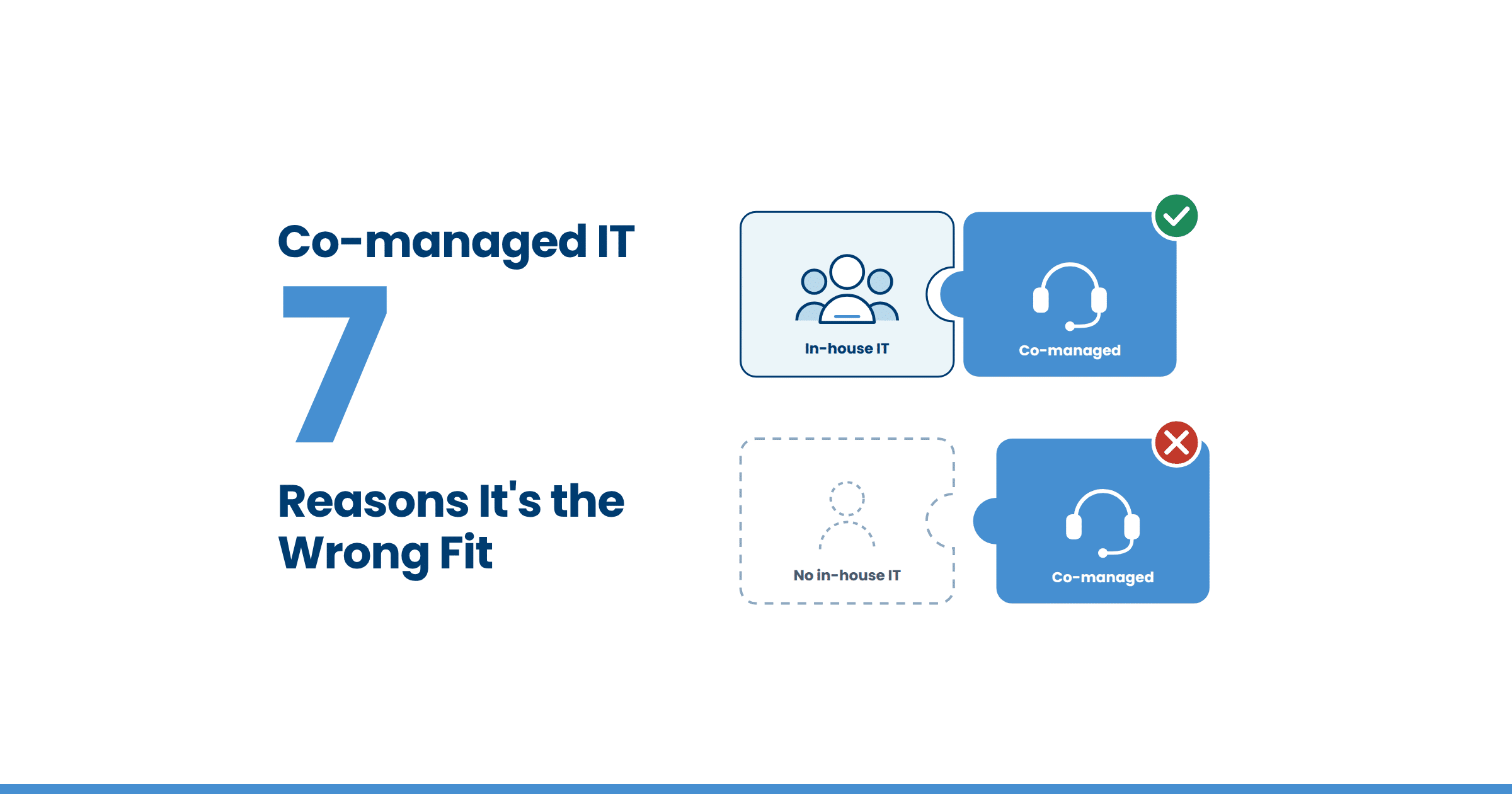
The co-managed IT services model is ideal for businesses that already have an IT department or IT personnel, and would like assistance in areas like:
- Help Desk Management
- Automation engineering
- Cloud Management
- Cybersecurity
- Governance, Risk and Compliance
- AI consulting
There are some common myths around what co-managed IT is and is not.
But essentially, co-managed services provide a collaborative approach where the managed IT services firm works collaboratively with an internal IT team to provide:
- Additional support
- Specialized expertise (e.g., GRC, security, automation & AI)
- Strategic IT consulting
Gar Whaley, Teal CRO and cofounder, shared what that might look like in action:
“Co-managed IT services is a situation where we sit down with a client and look over the technology solutions and determine which tasks they want us to handle,” explained Gar.
“So, for instance, they might have us manage their cybersecurity – pushing patches, doing the MDR, doing the antivirus, helping with compliance. All those security-related tasks.”
“Meanwhile, they handle everything in level one help desk with some bolted-on hours per month for any escalations they need,” explained Gar.
Key Differences Between Co-managed and Fully Managed IT Services
When choosing the right technical support for your business, it’s essential to understand the differences between co-managed and fully managed. These models differ significantly in terms of responsibility, control, scalability, and cost structure.
Let’s explore how each approach addresses unique business challenges and how they can support your organization’s goals.
Responsibility & Control
Co-managed IT Services
Imagine you’re running a busy restaurant. During regular business hours, your in-house team handles all the tasks seamlessly – taking orders, managing the kitchen, and ensuring a smooth dining experience.
But what happens during a sudden surge in customers or when a key staff member is absent?
Co-managing IT with a service provider works sort of like hiring temporary staff during rush hour. Your team handles the core activities like project management, while the additional staff fills gaps – ensuring no one is overwhelmed.
You’re still in control but have the support you need to keep things running smoothly.
Fully Managed IT Services
In contrast, fully managed IT services are like having an external management company oversee the restaurant’s entire daily operations.
They hire staff, manage the kitchen, maintain supplies, and even plan the menu.
This allows you to focus on your vision and growth, while the external team ensures smooth operations with little oversight on your part.
Scalability & Flexibility
Co-managed IT
This model scales by leveraging a blend of internal and external resources. As the business grows, you can flex services up or down without the need to adjust internal headcount; however, you will need to have good communication and careful planning with the managed IT services company.
Fully Managed IT
Fully managed services, on the other hand, offer greater scalability. All the IT responsibilities are handled by the IT support provider – making it easy for your organization to handle rapid growth or unexpected demand surges without straining you and your team.
You might choose this option, for example, when you want to focus your attention on the systems your business actually depends on (line-of-business apps, workflow tools, integrations, data).
Cost Considerations
Co-managed IT
The cost structure here is more flexible and can be tailored based on the shared responsibilities between the internal team and the co-managed IT provider.
This allows businesses to pay only for what they need, such as specialized expertise or overflow support – resulting in variable costs depending on usage and requirements.
Explore how co-managed IT services help you optimize your budget.
Fully Managed IT
These services typically come with a fixed monthly or annual subscription fee, offering predictable costs for budgeting.
Since the MSP handles everything, including day-to-day support and strategic planning, it’s a comprehensive solution that removes the need for hiring additional in-house IT staff.
Optimizing your IT investment starts here. Explore this MSP pricing guide to understand costs, factors, and models.
Advantages and Disadvantages of Each Model
Co-managed IT
Co-managed IT gives the business a perfect blend of control and external expertise, making it ideal for those who want to retain internal oversight. The flexibility of this model allows you to pay for specific needs – which results in long-term cost efficiency.
However, clearly defining roles and responsibilities between your internal team and the outsourced IT provider is vital to avoid any inefficiencies.
It’s equally important for IT leaders to ensure their entire IT team is on board, as some may feel uneasy about bringing in external support.
Communicating the value of this partnership early on can foster more effective collaboration and focus.
Managed IT
On the other hand, fully managed IT services provide network management, proactive monitoring, operational efficiency, and strategic guidance.
All of which frees you from day-to-day IT concerns – making the model ideal for IT leaders looking for a hands-off approach. Plus, it comes with predictable costs for easier budgeting.
While you gain a comprehensive solution, you may lose some degree of control. This may be a concern if you prefer having hands-on involvement.
Proactive communication with potential managed IT providers can alleviate these concerns and ensure a smooth integration.
Addressing Internal IT Struggles
You are likely very aware that small business IT teams are often overwhelmed because they’re juggling daily support tasks along with more complex, time-consuming projects.
This strain typically leads to longer ticket response times, a growing backlog, and reduced focus on strategic initiatives like digital transformation.
If your team is constantly “putting out fires” rather than innovating, it’s a clear sign that additional support may be needed. A co-managed IT services partner can step in to alleviate this pressure.
This support helps you and your team refocus on tasks that help the business as well as your professional development -which ultimately results in better productivity and greater job satisfaction.

Use this checklist to make choosing the right co-managed IT service provider for your team easy and stress-free.
How Each Model Helps Businesses Meet Compliance Regulations
When navigating complex regulations, choosing the right IT service model can make all the difference. Let’s explore two scenarios and see how each model addresses distinct compliance challenges.
Small Healthcare Provider
MediWell Health, a small clinic, must comply with HIPAA’s strict data protection rules.
They have an internal IT team, but they’re stretched thin managing day-to-day support requests. To meet compliance needs, they opted for co-managed IT services.
Now, their IT support provider handles the security monitoring and compliance auditing, while the in-house team manages the daily operations.
This synergy ensures they maintain HIPAA compliance without overburdening their team.
Midsized Defense Contractor
Apex TG Systems, a DoD manufacturer, needed to meet CMMC requirements without expanding its internal IT team.
To address compliance and operational gaps, the company engaged a CMMC-aligned managed IT services provider.
Their MSP now manages all core IT functions, including:
24/7 monitoring and security oversight
Help desk and endpoint support
Secure project execution
Strategic IT and compliance planning
This partnership supports CMMC readiness while improving security consistency, reducing internal workload, and eliminating the need to hire additional IT or compliance staff.
Use Cases: Which Service Model is Right for You?
If you’ve read the article up to this point, you probably have a solid understanding of which service model fits your business. But if you’ve jumped straight here, no worries! Here’s a quick breakdown:
Fully managed IT services are likely right for you if…
…you lack internal IT support, have limited IT expertise, or want to focus on tasks that are revenue-generating for the business.
An MSP will provide you with complete management, 24/7 support, and strategic guidance, ensuring that you can still leverage exceptional technology solutions without the need for recruiting in-house talent.
Additionally, this model is also suitable for organizations that require around-the-clock monitoring and quick resolution to prevent downtime or operational disruptions.
Your business may need managed IT services if you relate to a lot of these signs. Discover if managed services are the solution to your IT challenges.
Co-managed IT services are likely right for you if…
…you have established IT professionals that require additional expertise or support. This model allows you and your team to maintain control while benefiting from external skills, resources, and scalability.
It’s also a great choice if you’re experiencing temporary IT staff shortages or you’re looking to tackle specialized initiatives.
Choosing the Right IT Service Model
When deciding between these models, it’s important to consider which solution best aligns with your business operations. Both offer distinct advantages, whether it’s the hands-off approach and predictable budgeting of fully managed services, or the flexibility and control of co-managed solutions.
Once you’ve figured out what model you need, it’s time to locate the right service provider.
Finding the Right Co-managed IT Provider
When looking for the best co-managed IT service provider, it’s important to partner with one that understands your organization’s unique challenges.
Download this checklist to identify common co-managed IT red flags so you don’t overlook them.
Finding the Right Managed IT Provider
Of course, it’s equally important to identify the best managed IT service provider.
Use this checklist to make choosing the right managed service provider for your organization easy and stress-free.